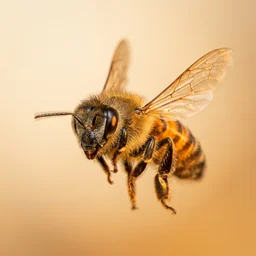
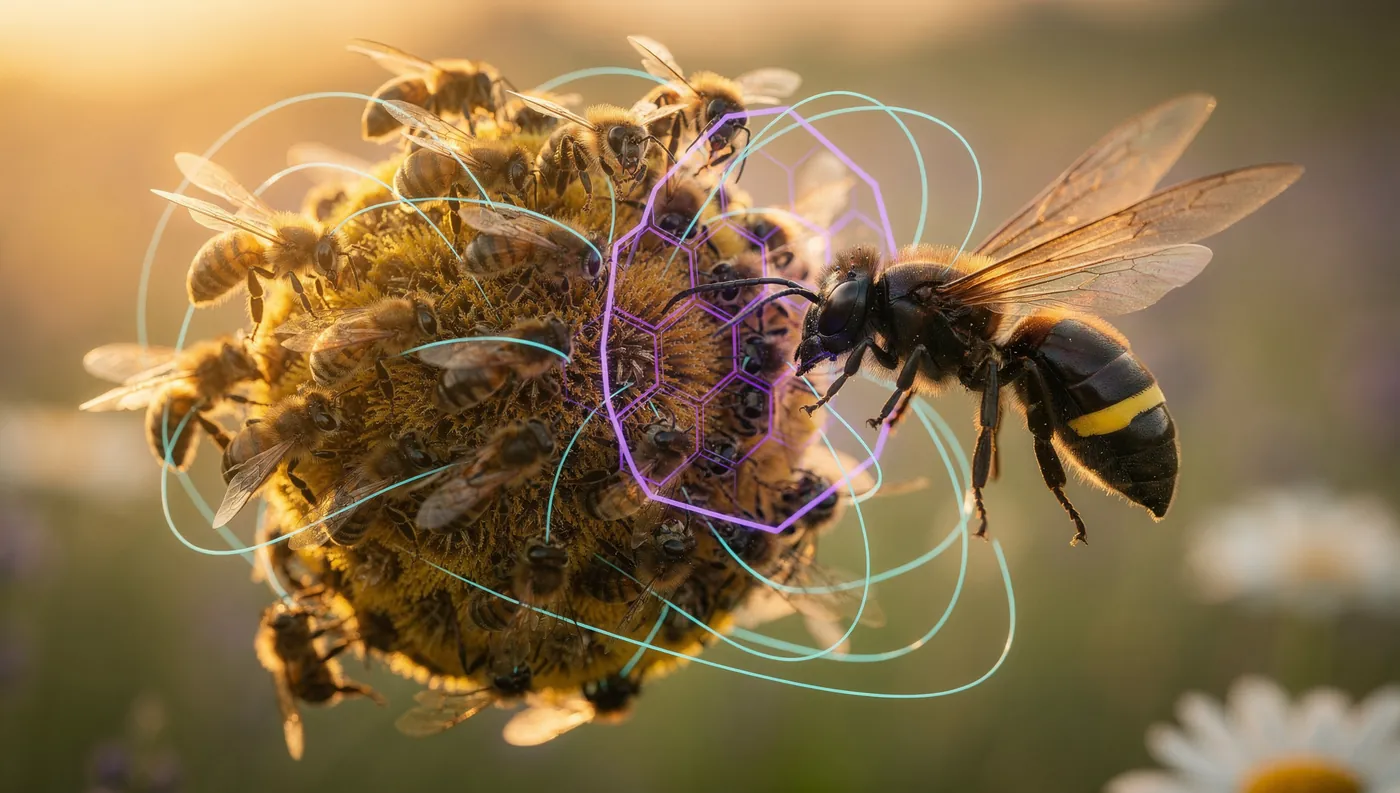
In the summer of 2006, researchers published footage of what happens when an Asian hornet (Vespa velutina) enters a Japanese honeybee colony (Apis cerana japonica). The hornet is three times the size of any individual bee, armoured and venomous. Within seconds of contact, hundreds of workers swarm it, forming a dense living sphere. They vibrate their flight muscles in unison. The internal temperature of the ball rises to 46 °C. The hornet dies at 45 °C. The bees survive at 48 °C.
No bee is in charge. No signal goes to a queen. The response is distributed, decentralised and lethal - triggered entirely by shared chemical signal and a shared threshold. The colony does not debate the threat. It executes.
The biology in numbers
The margin is razor-thin and intentional. Evolution did not give the bees a comfortable 20 °C buffer. It gave them exactly enough - and the precision to operate inside it collectively, without error.
| Parameter | Asian hornet | Honeybee worker | Outcome |
|---|---|---|---|
| Lethal temperature | 45 °C | 48 °C | 3 °C operating margin |
| Heat-ball temperature | 46 °C sustained ~20 min | Threat neutralised | |
| Coordination mechanism | Pheromone signal + vibration threshold | Fully decentralised | |
| Time to response | <30 seconds from first contact | Faster than any command chain | |
| Individual bee loss | ~5 to 10% of ball bees perish | Accepted cost for colony survival |
The cyber translation
Most organisations respond to cyber incidents the way European honeybees (Apis mellifera) respond to hornets: one bee at a time, each one losing. The European subspecies has not co-evolved with Vespa velutina and has not developed the heat-ball defence. It is being devastated across France, Spain and the United Kingdom as a result. The parallel is not subtle.
The scout bee's waggle dance encodes direction, distance and quality of a target - other bees decode it and fly directly, with no manager involved. The cyber equivalent is a threat intelligence signal: an Indicator of Compromise (IOC) propagated automatically to all detection layers, no ticket required.
The pheromone alarm threshold means that when chemical concentration reaches a value, bees act simultaneously - the threshold is the policy, not a person. The cyber equivalent is an automated playbook trigger: risk score breaches a defined threshold, containment fires without human approval.
The heat-ball itself is distributed, parallel execution - each bee contributes, the aggregate produces the lethal outcome. The cyber equivalent is a coordinated incident response where SOC, network, endpoint and identity teams act in parallel on the same incident object, with no serial handoffs.
And 46 °C - not 50 °C - is precision as survival. Overshoot costs bees; undershoot loses the colony. The margin is calibrated, not maximised. The cyber equivalent is proportionate containment: isolate the affected segment, not the entire estate.
What the heat-ball demands of your architecture
The heat-ball is not a tactic - it is an emergent property of a well-designed information architecture. The bees succeed because every worker has access to the same signal at the same time, because the threshold for action is embedded in biology rather than bureaucracy, and because the response is parallel by design. Replicate all three properties or replicate none of them.
In practice: a single authoritative asset inventory (every bee knows where the hive is), automated propagation of threat signals to all detection layers without manual relay, pre-approved playbooks that execute at threshold without escalation delay, and post-incident thermal mapping - understanding which parts of the response operated closest to their own 48 °C limit, and why.
Under the EU Digital Operational Resilience Act (DORA), this is not a metaphor. Articles 11 and 26 demand documented, tested and evidenced ICT incident-response capabilities. The question a supervisor will ask is not "did you respond?" but "can you demonstrate the response was pre-computed, threshold-triggered and proportionate?" The bees can. Can you?
The hornet chose the wrong hive
The Asian hornet succeeds against unprepared colonies and fails against prepared ones. The preparation is entirely informational: shared signal, shared threshold, shared execution. The hornet has not changed. The colony has. That is the entirety of the cyber-resilience argument, rendered in fur and chitin at 46 °C.